
Live Dragon Tiger Strategy, Card Mechanics, and Odds for Bangladeshi Players

Dragon Tiger is frequently described as a two-card baccarat, but that simplification understates what makes the game compelling. With one card dealt to Dragon and one card dealt to Tiger, every single round resolves in roughly twenty-five seconds. There are no drawing tableaux to memorize, no third-card rules to calculate on the fly, and no player decisions required after you lock in your wager. The highest card value wins, King reigns supreme, and Ace sits at the very bottom.
Yet despite its apparent simplicity, Dragon Tiger presents specific mathematical realities that trip up casual bettors in Bangladesh. The speed of the shoe can devour a bankroll if you chase volatile side wagers, and the standard payout structure hides a sharp house advantage on particular outcomes. Whether you are placing ৳50 wagers on your mobile browser or staking ৳5,000 on high-limit Evolution or Ezugi tables at Takabet, understanding the distribution of cards, tie payouts, and deck penetration will transform how you approach every single hand.
Game Rules and Basic Structure
Every round of Dragon Tiger uses a standard shoe consisting of six or eight English decks of 52 cards, thoroughly shuffled and placed inside an automated dealing shoe or managed by a live croupier. Suits do not affect winning hierarchy. The rankings run strictly in ascending order:
- Ace: Lowest card (value 1)
- 2 through 10: Numerical face value
- Jack: Value 11
- Queen: Value 12
- King: Highest card (value 13)
Before any cards emerge from the shoe, a digital countdown runs on your screen—typically lasting between 12 and 15 seconds. During this window, you place your chips on the virtual layout.
The dealer draws the first card face-up and delivers it to the Dragon betting position on your left. The dealer immediately draws the second card face-up and delivers it to the Tiger betting position on your right.
Whichever position holds the higher card wins the round immediately. If Dragon holds a 9 and Tiger shows a 7, Dragon bettors collect an even-money return (1:1). If Tiger holds a Queen and Dragon holds a Jack, Tiger takes the win.
+-------------------------------------------------------------------+
|                     DRAGON TIGER CARD HIERARCHY                   |
+-------------------------------------------------------------------+
| A (1) < 2 < 3 < 4 < 5 < 6 < 7 < 8 < 9 < 10 < J (11) < Q (12) < K (13) |
|                     Suit plays zero role in outcome               |
+-------------------------------------------------------------------+
The critical rule twist occurs when both positions receive cards of identical numerical rank. This is known as a Tie. When a tie occurs:
- Players who wagered on the Tie proposition bet win an 8:1 payout (or 11:1 depending on the specific provider variant).
- Players who wagered on the main Dragon or Tiger positions lose 50% of their stake. The remaining half is returned to your account balance.
This 50% deduction on ties provides the casino with its foundational house edge on the main bets.
Bet Types, Mathematical Payouts, and House Edge
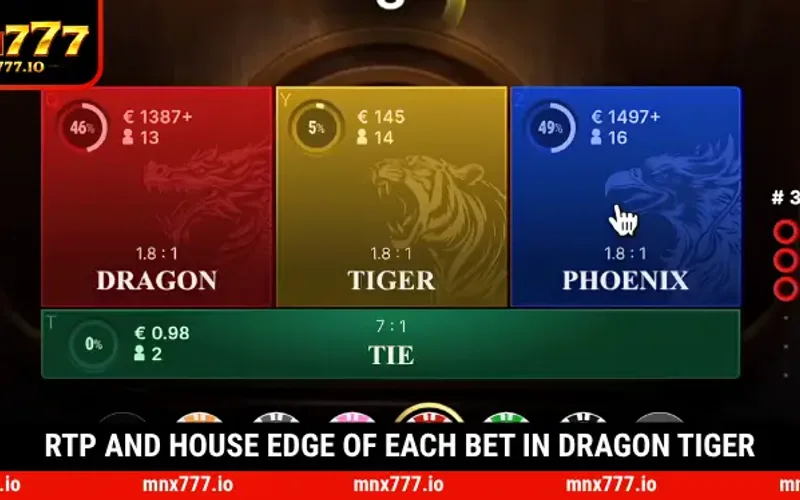
To build a sustainable bankroll strategy, you must understand the mathematical edge baked into every sector of the betting felt. Dragon Tiger tables offer several betting options beyond the core two sides:
| Bet Option | Winning Condition | Standard Payout | Mathematical House Edge | Volatility Profile |
|---|---|---|---|---|
| Dragon | Dragon card value strictly higher than Tiger | 1:1 (Half returned on Tie) | 3.73% | Low |
| Tiger | Tiger card value strictly higher than Dragon | 1:1 (Half returned on Tie) | 3.73% | Low |
| Tie | Dragon and Tiger hold identical card ranks | 8:1 (or 11:1 on selected tables) | 32.77% (at 8:1) / 10.36% (at 11:1) | Extremely High |
| Suited Tie | Dragon and Tiger share identical rank and suit | 50:1 | 13.98% | Maximum |
| Big (Over 7) | Chosen side receives 8, 9, 10, J, Q, or K | 1:1 (7 loses completely) | 7.69% | Moderate |
| Small (Under 7) | Chosen side receives A, 2, 3, 4, 5, or 6 | 1:1 (7 loses completely) | 7.69% | Moderate |
| Odd / Even | Selected side rank is odd or even | 1:1 (7 loses completely) | 7.69% | Moderate |
| Red / Black | Selected side card is diamond/heart or spade/club | 1:1 (7 loses completely) | 7.69% | Moderate |
Notice the critical role played by the card 7 on all side wagers. Whenever a 7 appears on a side that you wagered as Big, Small, Odd, Even, Red, or Black, the house automatically takes your entire stake. The seven acts as the casino's "house zero", pushing the edge on side propositions to 7.69%.
The Tie Bet: Why You Must Treat It With Caution
The 8:1 payout on the Tie bet looks attractive on the screen, especially when a player hits two consecutive ties and turns a small wager into a substantial payout. However, in an eight-deck shoe containing 416 cards, there are 86,320 possible two-card combinations. Only 6,448 of those combinations result in identical ranks.
The mathematical probability of a tie landing on any given round is roughly 7.47%, or once every 13.4 hands. When the house pays 8:1 on an event that occurs once every 13.4 attempts, the resulting house edge is an astounding 32.77%.
For every ৳1,000 you cycle through standard tie bets over time, the expected theoretical loss is approximately ৳328. In contrast, wagering on Dragon or Tiger surrenders an expected loss of roughly ৳37 per ৳1,000 cycled.
Theoretical Loss Comparison on ৳10,000 Total Wagered Turnover:
-------------------------------------------------------------
Dragon / Tiger Main Bet: Expected loss ~ ৳373
Tie Proposition Bet:     Expected loss ~ ৳3,277
If you enjoy the thrill of hunting high payouts, look for modern live tables such as Evolution's Super Sic Bo or Lightning Dragon Tiger, where random multipliers can boost tie returns to 50:1 or higher. On standard live tables, allocating more than 5% of your bankroll to ties will rapidly erode your starting capital.
Reading Roadmaps and Bead Plates in Live Dealer Lobbies
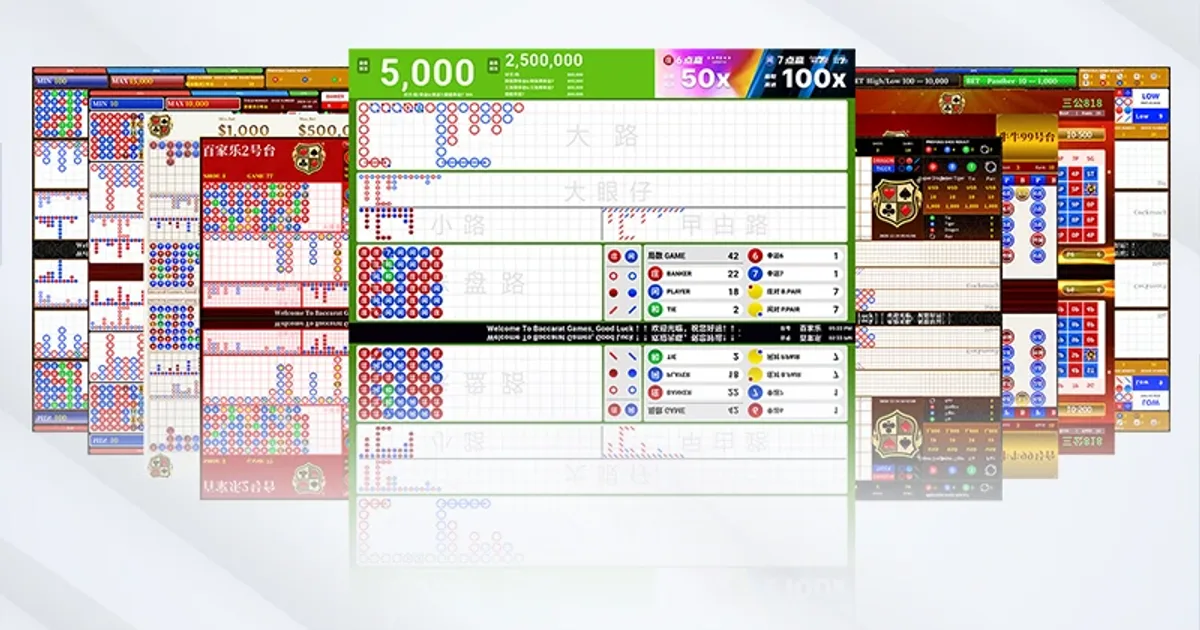
Every modern live casino interface displays electronic roadmaps tracking previous outcomes across the current shoe. Understanding how these boards function prevents common misinterpretations.
The Bead Plate
The Bead Plate provides an exact chronological record of every round played since the shoe began. Each cell marks the winner:
- Red circle with a Chinese character or letter "D" represents a Dragon win.
- Blue circle with "T" represents a Tiger win.
- Green circle with "Tie" represents a tie hand.
The Big Road
The Big Road organizes streaks into vertical columns. Whenever Dragon wins consecutively, the column drops downward in red. As soon as Tiger breaks the streak, the tracking starts a brand-new column to the right in blue. If a tie occurs, a green slash is drawn across the most recent circle rather than starting a new column.
The Derived Roads (Big Eye Boy, Small Road, Cockroach Pig)
Derived roads do not indicate whether Dragon or Tiger won. Instead, they measure consistency and repetition. If the shoe is alternating in predictable patterns (such as Dragon, Tiger, Dragon, Tiger), the derived roads display red marks indicating order. If the shoe is breaking patterns erratically, the derived roads display blue marks representing chaos.
Crucial Reality Check: Roadmaps are historical displays, not predictive crystal balls. Past rounds have zero physical impact on which card rests at the top of the dealing shoe. Use roadmaps to manage your entry points and betting discipline, but never assume a streak "must break" because red has landed six times in a row.
Card Counting Mechanics: Does It Actually Work?
Because Dragon Tiger burns only two cards per round without complex drawing conditions, card counting appears theoretically feasible. Bettors often wonder whether tracking cards can grant them an edge over the live dealer.
In physical brick-and-mortar gaming with deep penetration (where dealers deal out 85% to 90% of an eight-deck shoe before shuffling), counting low cards versus high cards can indeed provide a marginal positive expectation on the Big/Small and Tie wagers toward the end of the shoe. If a massive concentration of 8s, 9s, 10s, and picture cards remain in the deck, betting Big carries a statistical advantage.
In live dealer studios broadcast across Takabet and modern online portals, however, operators implement three safeguards:
- Shuffling Penetration Limits: Live croupiers cut the eight-deck shoe at roughly 50% to 60% depth. A plastic cut card triggers an immediate shoe replacement well before the deck becomes mathematically vulnerable.
- Continuous Shuffling Machines (CSMs): Some live studios use automated continuous shuffle technology, returning used cards directly back into the mechanism after each round.
- Burn Cards: Studio procedures include burning a card face-down prior to each round, introducing unknown variables into the remaining composition.
While keeping a loose mental count of whether Kings or Aces have clustered in recent rounds can guide your secondary decisions, relying on formal card counting as a primary profit vehicle in live dealer Dragon Tiger is impractical. Solid bankroll sizing and disciplined flat betting deliver far superior stability.
Step-by-Step Guide to Playing Dragon Tiger at Takabet
Follow these practical steps to access and play live Dragon Tiger on mobile or desktop:
Log In and Fund Your Balance
Ensure your Takabet account has sufficient real-money funds. Use fast local mobile payment methods like bKash, Nagad, or Rocket to credit your wallet in Bangladeshi Taka (৳). Most live dealer tables accept minimum bets starting from ৳50 to ৳100.
Navigate to the Live Casino Lobby
Open the main menu and select Live Casino Games. Filter by provider—Evolution Gaming, Ezugi, AE Sexy, and Pragmatic Play Live all host active 24/7 Dragon Tiger tables.
Choose Your Table Limit
Select a table that matches your bankroll. If you have ৳2,000 deposited, choose a table with a ৳50 minimum limit. This ensures you can comfortably absorb normal short-term swings across 30 to 40 rounds of play.
Place Your Chip Within the Time Window
Click your desired chip denomination and tap the Dragon or Tiger betting zone. Avoid scattering random chips across every side bet. Lock in your choice before the digital timer hits zero.
Observe the Deal and Receive Automatic Payouts
The live dealer draws both cards in high-definition video. The screen displays the numerical result instantly, and winning payouts are credited directly to your player wallet without delay.
Effective Bankroll Management and Betting Frameworks
Because Dragon Tiger is rapid-fire, the number of bets you place per hour is among the highest of any casino offering. Without strict boundaries, an unstructured session can run through your daily gaming budget in twenty minutes.
The 2% Bankroll Rule
Never wager more than 2% of your active session balance on a single hand. If you deposit ৳5,000, your baseline flat bet should be ৳100. This cushion protects your balance against the mathematical variance of five or six consecutive losses, giving you room to recover during winning runs.
The Trap of the Martingale System
Many players attempt the Martingale progression on Dragon Tiger: doubling their bet after every loss (৳100 -> ৳200 -> ৳400 -> ৳800 -> ৳1,600 -> ৳3,200).
While this looks mathematically sound on paper, it is dangerous in practice. Seven consecutive losses will wipe out a ৳10,000 bankroll while chasing a tiny ৳100 profit. Furthermore, every live table enforces maximum bet limits (table caps) that will prevent you from doubling your bet once you reach the ceiling.
The Math of a 7-Loss Martingale Run (Starting Bet ৳100):
Loss 1: ৳100
Loss 2: ৳200
Loss 3: ৳400
Loss 4: ৳800
Loss 5: ৳1,600
Loss 6: ৳3,200
Loss 7: ৳6,400
Cumulative Outlay: ৳12,700 — All risked to recover a single ৳100 profit!
Establish Concrete Win and Loss Stops
Before placing your opening chip, set two firm boundaries:
- Profit Target: If you grow your starting balance by 30% to 50% (e.g., turning ৳3,000 into ৳4,500), close the table and request a local withdrawal via Nagad or bKash.
- Stop-Loss Limit: If you lose 40% of your initial session budget, step away for the day. Never re-deposit instantly in an attempt to win back lost stakes during an emotional downturn.
Comparing Popular Studio Variants
Not all Dragon Tiger games are identical. Providers tweak side rules, pacing, and visual environments to suit different player preferences:
- Evolution Live Dragon Tiger: Features studio lighting that changes dynamically based on the winning side, ultra-crisp optical card recognition, and standard 8:1 tie payouts with 50:1 suited ties.
- Ezugi Dragon Tiger: Broadcast from state-of-the-art Asian studios with localized chat interfaces, offering rich historical bead charts and side wagers including individual card suits and color splits.
- Pragmatic Play Live Dragon Tiger: Known for clean camera transitions, fast round cycles (under 22 seconds), and side bets covering specific card ranges.
- AE Sexy Dragon Tiger: Emphasizes high-energy, engaging dealers with upbeat background music and interactive on-screen tipping options.
To understand how provider platforms stack up against one another, explore our comprehensive reviews of Evolution Gaming Live Tables and AE Sexy Gaming Studios.