
Real Money Teen Patti Guide: Hand Sequences, Live Dealer Rules, and Side Bet Math
In the cultural tapestry of South Asian social entertainment, few card games rival the prestige, excitement, and widespread familiarity of Teen Patti (literally translated as "Three Cards"). Often hailed across Bangladesh and India as the regional equivalent of traditional three-card poker, Teen Patti has been played for generations during Diwali celebrations, Eid festivities, and social gatherings.
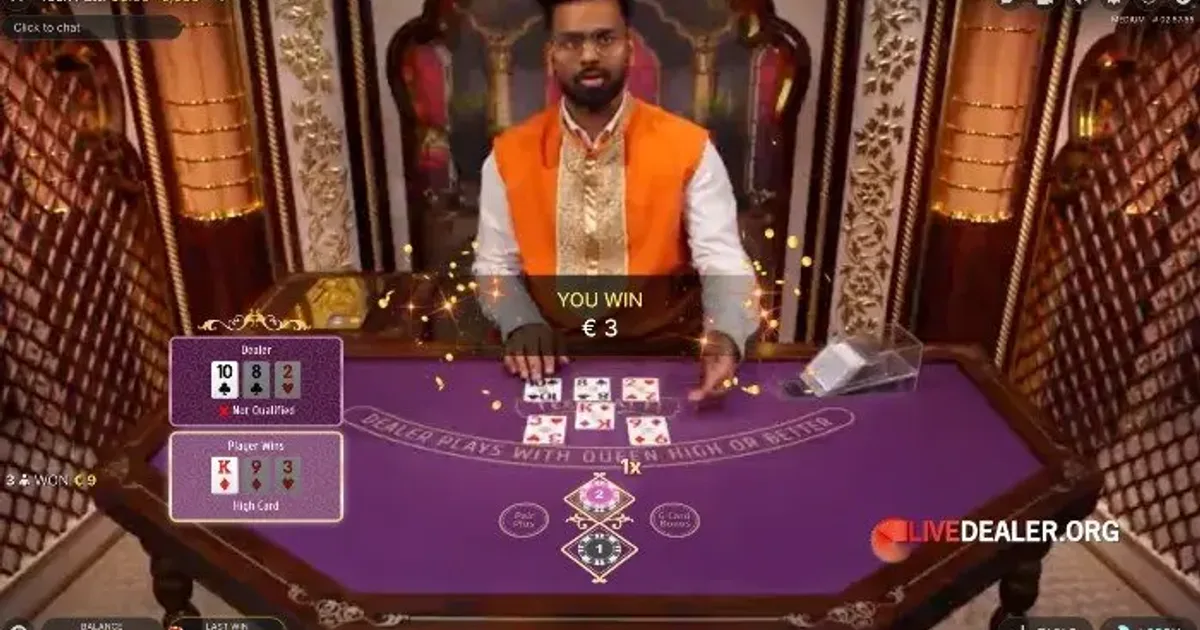
With the evolution of international live dealer gaming studios, Teen Patti has successfully transitioned into a premier digital casino table game. Broadcast in real time by world-renowned studios like Ezugi and Evolution Gaming, modern live dealer Teen Patti allows Bangladeshi players to test their skills and card evaluations against certified professional human dealers dealing physical cards under high-definition cameras.
However, playing Teen Patti in an international live casino studio operates under a slightly different framework than casual home games with friends. Instead of competing in a multi-player bluffing ring with a shared pot, live casino Teen Patti is played directly against the house dealer, incorporating strict dealer qualifying requirements, structured Play-or-Fold decisions, and high-payout optional side bets.
This comprehensive guide, authored by senior gaming mathematician Tanvir Hassan, provides an exhaustive analytical manual for Real Money Teen Patti on Takabet. We break down the official three-card hand ranking hierarchy, explain dealer qualifying mechanics, calculate side bet payout matrices, outline mathematically optimal playing strategies, and present disciplined bankroll management safeguards.
The Hand Rankings Hierarchy: From Trail to High Card
Unlike traditional five-card poker, Teen Patti hands are evaluated using strictly three physical cards. Because fewer cards are involved, the mathematical probabilities of forming specific combinations differ from standard poker, establishing a unique hand ranking hierarchy:
[ Trail / Trio (Three of a Kind) ] ── Highest Value
               │
               â–¼
   [ Pure Sequence (Straight Flush) ]
               │
               â–¼
      [ Sequence (Straight) ]
               │
               â–¼
        [ Color (Flush) ]
               │
               â–¼
             [ Pair ]
               │
               â–¼
       [ High Card ] ── Lowest Value
Trail / Trio (Three of a Kind)
Three cards of the exact same rank regardless of suit (e.g., three Aces: A-A-A, or three Sevens: 7-7-7).
- Probability: Approximately 0.24% (1 in 425 hands).
- Three Aces (
A-A-A) represents the highest possible hand in Teen Patti, followed byK-K-Kdown to2-2-2.
Pure Sequence (Straight Flush)
Three consecutive cards of the exact same suit (e.g., A-K-Q of Spades, 9-8-7 of Hearts, or 4-3-2 of Clubs).
- Probability: Approximately 0.22% (Pure Sequence is statistically rarer than a standard Sequence).
- The highest Pure Sequence is
A-K-Q, followed byA-2-3, down to4-3-2.
Sequence (Straight / Normal Run)
Three consecutive cards of mixed suits (e.g., 8 of Hearts, 7 of Clubs, 6 of Diamonds).
- Probability: Approximately 3.26%.
- The highest Sequence is
A-K-Q, followed byA-2-3, down to4-3-2.
Color / Flush
Three non-consecutive cards of the exact same suit (e.g., King, 9, and 4 of Diamonds).
- Probability: Approximately 4.96%.
- If two players hold a Color, the hand with the highest individual card wins. If the highest cards match, the second card is compared, then the third.
Pair (Double)
Two cards of the exact same rank plus one unmatched kicker card (e.g., 10-10-5 or Queen-Queen-Ace).
- Probability: Approximately 16.94%.
- A pair of Aces (
A-A-X) is the highest pair, followed by Kings down to Twos. If pairs match, the higher kicker card breaks the tie.
High Card
Three unrelated cards that form no pair, sequence, or flush (e.g., Ace, 10, 4 of mixed suits).
- Probability: Approximately 74.39% (the most common hand dealt).
- Hands are ranked by their highest single card.
Live Casino Teen Patti: Playing Against the Dealer
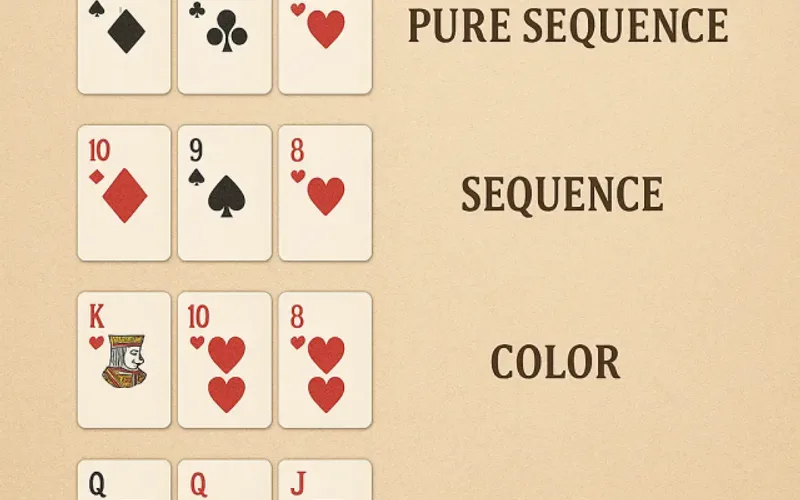
In live dealer studios like Ezugi, Teen Patti is structured as an Ante-Bet game where your hand competes directly against the dealer’s hand:
Step 1: Placing the Ante Wager
Before any cards are dealt, you place an Ante bet (e.g., 500 BDT) in the main betting circle. You can also choose to place optional side bets (Pair Plus or 6-Card Bonus) during this window.
Step 2: The Initial Deal
The physical human dealer shuffles a single 52-card deck and deals three cards face-up to the Player position, and three cards face-down to the Dealer position.
Step 3: The Decision: Play or Fold
You inspect your three face-up cards and make an informed tactical decision:
- Fold: If you believe your hand is too weak to beat the dealer, you tap Fold. You forfeit your Ante bet, and the round ends immediately for you.
- Play (Call): If you wish to challenge the dealer, you tap Play. The system automatically places a Play Bet equal to exactly 1x your initial Ante (if your Ante was 500 BDT, your Play bet is 500 BDT, bringing your total stake to 1,000 BDT).
Step 4: The Dealer Reveal and the "Queen-High" Qualifying Rule
The dealer turns over their three cards. For the game to resolve in an active contest, the dealer’s hand must "Qualify":
- The Dealer Qualifying Threshold: The dealer must hold at least Queen-High or Better (meaning a hand containing at least Queen-X-X, King-X-X, Ace-X-X, or any Pair, Sequence, Color, or Trail).
- If the Dealer DOES NOT Qualify (Dealer Holds Jack-High or Worse):
- Your Ante bet is paid 1 to 1 even money.
- Your Play bet is a "Push" and returned to your balance with zero deduction. You win a profit on your Ante without risking your Play wager.
- If the Dealer QUALIFIES and Your Hand Beats the Dealer:
- Both your Ante bet AND your Play bet are paid 1 to 1 even money.
- If the Dealer QUALIFIES and Beats Your Hand:
- You lose both your Ante and Play bets.
- If Both Hands Tie Exactly:
- Both the Ante and Play bets are a Push and returned in full to your account.
Live Teen Patti Side Bets: Payout Matrices and Mathematical Traps
Live studios offer two primary high-volatility side bets designed to deliver massive payouts on premium hands:
The Pair Plus Side Bet
The Pair Plus wager evaluates your three cards exclusively, completely ignoring what the dealer holds and regardless of whether the dealer qualifies:
- If your three cards contain a Pair or Better, you win according to this standardized payout table:
- Trail / Trio (Three of a Kind): Pays 50 to 1
- Pure Sequence (Straight Flush): Pays 30 to 1
- Sequence (Straight): Pays 10 to 1
- Color (Flush): Pays 5 to 1
- Pair: Pays 1 to 1 (Even money)
- Mathematical House Edge: The Pair Plus bet carries an average house edge of approximately 4.50%. While higher than the main game, it offers frequent hits due to the high probability (16.94%) of hitting a simple pair.
The 3+3 Bonus / 6-Card Bonus Side Bet
This side bet combines your three cards and the dealer's three cards into a single 6-card pool to form the best possible traditional 5-card poker hand:
- Royal Flush: Pays 1000 to 1
- Straight Flush: Pays 200 to 1
- Four of a Kind: Pays 100 to 1
- Full House: Pays 20 to 1
- Flush: Pays 15 to 1
- Straight: Pays 10 to 1
- Three of a Kind: Pays 5 to 1
- Mathematical House Edge: The 6-Card Bonus carries a steep house edge exceeding 8.50% to 10.0%. Treat this as a high-volatility lottery ticket rather than a core betting strategy.
Optimal Playing Strategy: When to Play and When to Fold
Because live casino Teen Patti is mathematically equivalent to Three Card Poker, statistical researchers have mapped out the mathematically optimal basic strategy:
The "Q-6-4" Rule (The Optimal Strategy Benchmark)
To minimize the casino’s mathematical house edge to its lowest possible baseline of 2.14% on Ante:
- PLAY (Call) if your hand is Queen-Six-Four (Q-6-4) or Higher: This means you should always play if your hand contains:
- Any Pair, Color, Sequence, Pure Sequence, or Trail.
- Any hand with an Ace-high or King-high (e.g.,
A-2-3,K-8-5). - Any hand with a Queen-high, provided your second highest card is a 6 or higher (e.g.,
Q-7-2,Q-8-4,Q-J-3), or if your second card is a 6, your third card is a 4 or higher (Q-6-4).
- FOLD if your hand is Lower than Q-6-4: If your highest card is a Jack (e.g.,
J-10-8), a Ten, or a Queen with weak kickers (e.g.,Q-5-3), you must Fold immediately. Folding forfeits only your 1x Ante, saving your 1x Play bet from an inevitable statistical loss against the dealer’s qualifying threshold.
Following this simple Q-6-4 strategy strictly eliminates guesswork and preserves your bankroll over long-term sessions.
Bankroll Discipline and Table Etiquette
Because live dealer Teen Patti deals approximately 45 to 60 hands per hour, bankroll management is essential:
- Account for the Double Wager: Remember that when you play a hand, your total wager will be 2x your Ante (Ante + Play). If your standard bet unit is 200 BDT, your Ante should be set at 100 BDT so your total outlay on a played hand does not exceed your planned unit size.
- Limit Side Bet Exposure: Allocate no more than 10% to 15% of your betting capital to Pair Plus or 6-Card side bets. The primary game carries a much friendlier 2.14% house edge.
- Establish Session Win/Loss Limits: Decide in advance when you will conclude your session (e.g., stopping when your balance increases by 30% or drops by 25%). Review our Responsible Gaming Policy to set sensible personal boundaries before entering any table.