
Live Blackjack Guide: Basic Strategy Charts, Table Rules, and House Edge Optimization
Among all the card games offered in premier digital casinos, Blackjack holds a revered status among serious gaming enthusiasts and mathematicians. While games like roulette or baccarat involve passive outcomes decided purely by chance, blackjack is a game of active decision-making. Every card dealt requires an informed tactical choice: to Hit, Stand, Double Down, or Split.
Because player choices directly impact the outcome of every hand, blackjack is mathematically unique: it is one of the only commercial casino games where applying strict, mathematically verified Basic Strategy can reduce the casino’s built-in house advantage to an astonishingly low 0.40% to 0.60%.
Across Bangladesh, live dealer blackjack streamed from world-class studios like Evolution Gaming and Pragmatic Play has surged in popularity. Players can sit at authentic 7-seat green felt tables or join scalable Infinite Blackjack lobbies, playing directly against professional human dealers dealing physical 8-deck shoes in real time.
However, playing live blackjack without understanding basic strategy charts or falling for common traps like the "Insurance Bet" can multiply the casino’s mathematical edge fivefold.
This comprehensive guide, authored by senior gaming mathematician Tanvir Hassan, provides an exhaustive analytical manual for Live Blackjack on Takabet. We explain fundamental table rules, present the complete basic strategy decision matrix, analyze dealer upcard probabilities, expose the mathematical trap of insurance, and outline disciplined bankroll management safeguards.
The Objective and Fundamental Rules of Live Blackjack
The foundational goal of blackjack is frequently misunderstood by casual players. Your objective is not simply to get as close to 21 as possible—your true objective is to beat the dealer’s hand without exceeding 21:
Hand Point Values
- Cards 2 through 10: Count at their exact face value.
- Jack, Queen, and King (Face Cards): Count as 10 points each.
- Ace: Counts dynamically as either 1 or 11 points, whichever is more advantageous to the hand. A hand containing an Ace counted as 11 is known as a "Soft Hand" (e.g., Ace + 6 = Soft 17); a hand with no Ace or where an Ace must count as 1 to avoid busting is a "Hard Hand" (e.g., 10 + 6 = Hard 16).
The Natural Blackjack
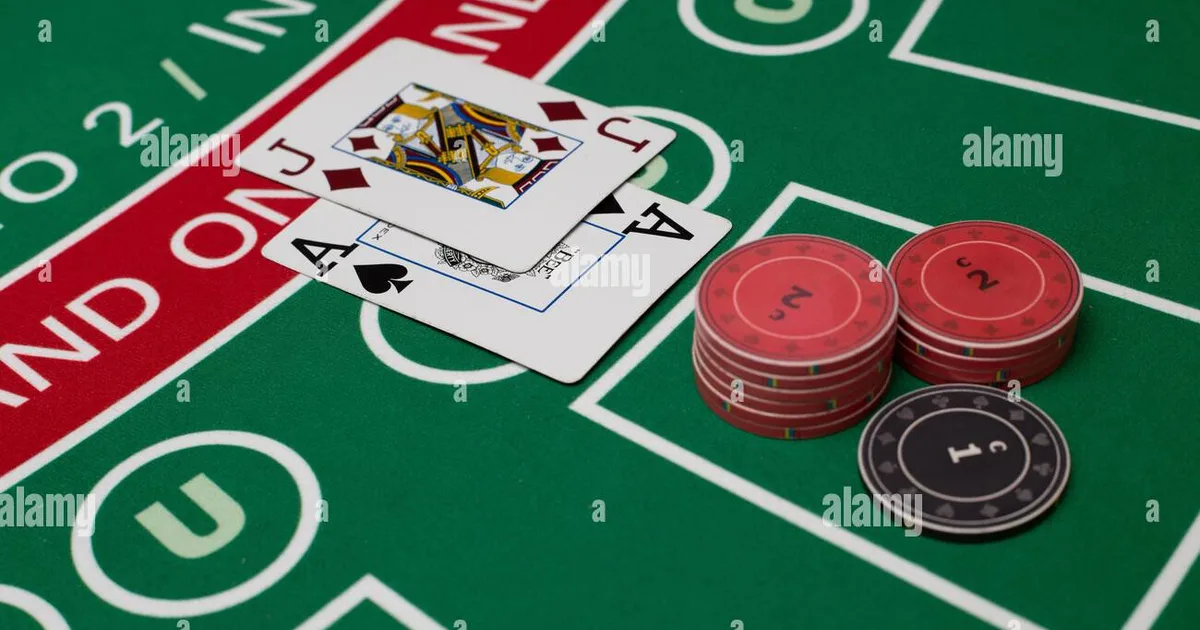
If your initial two cards are an Ace and a 10-value card (10, J, Q, K), you hold a Blackjack (Natural 21). In standard live dealer tables, a natural blackjack pays 3 to 2 (paying 1.5x your stake). For example, a 1,000 BDT bet returns 1,500 BDT in net profit. (Always avoid tables that pay 6 to 5 on blackjack, as this single rule change increases the house edge by a massive 1.39%).
The Dealer’s Mandatory Tableau
Unlike players who have complete tactical freedom, the dealer is an automated agent bound by strict, unyielding rules:
- The dealer must hit on any total of 16 or lower.
- The dealer must stand on all totals of 17 or higher (in standard European/Vegas rules, dealers stand on Soft 17).
- The dealer cannot double down, split pairs, or surrender.
The Four Player Decisions Explained
When the initial deal is complete (two cards face-up to each player, one card face-up and one card face-down to the dealer), you must make your tactical move:
Stand
You take no further cards and conclude your turn with your current point total.
Hit
You request an additional card from the dealer. You can continue hitting until your hand reaches your desired total or you exceed 21 (known as a "Bust"). If you bust, your wager is lost immediately, regardless of what the dealer subsequently does.
Double Down
You double your initial wager (placing a second bet equal to your original stake) in exchange for receiving exactly one additional card, after which your turn automatically concludes.
- Optimal Scenarios: Doubling down is mathematically favorable when you hold a strong starting total of 10 or 11, particularly when the dealer shows a weak upcard (such as a 4, 5, or 6).
Split Pairs
If your initial two cards are of identical numerical rank (e.g., two 8s, two Aces, or two 7s), you can place an additional wager equal to your original stake to split the cards into two separate, independent hands:
- The dealer deals a second card to each split card, and you play each hand individually.
- Golden Rule: Always split Aces and 8s. Never split 10s or 5s.
The Complete Basic Strategy Decision Matrix
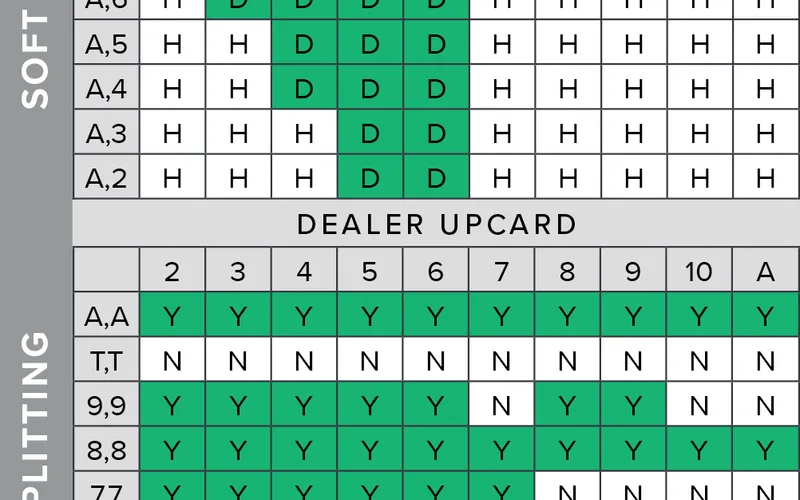
Basic strategy is not a matter of intuition, gut feeling, or luck. It is a mathematically proven, computer-simulated decision matrix that determines the single action (Hit, Stand, Double, or Split) that maximizes your statistical Expected Value (+EV) for every possible player hand against every possible dealer upcard:
Hard Hands Decision Matrix (Hands Without an Ace, or Ace Counted as 1)
- 8 or Lower: Always Hit.
- 9: Double Down if dealer shows 3, 4, 5, or 6; otherwise Hit.
- 10: Double Down if dealer shows 2 through 9; Hit if dealer shows 10 or Ace.
- 11: Double Down if dealer shows 2 through 10; Hit if dealer shows Ace.
- 12: Stand if dealer shows 4, 5, or 6; otherwise Hit (Hit against 2, 3, and 7 through Ace).
- 13, 14, 15, or 16: Stand if dealer shows 2, 3, 4, 5, or 6 (the "Dealer Bust Cards"); Hit if dealer shows 7, 8, 9, 10, or Ace.
- 17 or Higher: Always Stand.
Soft Hands Decision Matrix (Hands With an Ace Counted as 11)
- Soft 13 or Soft 14 (A,2 or A,3): Double Down if dealer shows 5 or 6; otherwise Hit.
- Soft 15 or Soft 16 (A,4 or A,5): Double Down if dealer shows 4, 5, or 6; otherwise Hit.
- Soft 17 (A,6): Double Down if dealer shows 3, 4, 5, or 6; otherwise Hit.
- Soft 18 (A,7): Double Down if dealer shows 3, 4, 5, or 6; Stand if dealer shows 2, 7, or 8; Hit if dealer shows 9, 10, or Ace.
- Soft 19 or Higher (A,8 or A,9): Always Stand.
Pairs Splitting Matrix
- Aces and 8s: Always Split (splitting Aces gives you two shots at 21; splitting 8s breaks up a terrible starting total of 16 into two fresh starting hands of 8).
- 2s, 3s, and 7s: Split if dealer shows 2 through 7; otherwise Hit.
- 4s: Hit (Split only if dealer shows 5 or 6 and double-after-split is permitted).
- 5s: Never Split (Treat as a Hard 10: Double Down against 2 through 9; otherwise Hit).
- 6s: Split if dealer shows 2 through 6; otherwise Hit.
- 9s: Split if dealer shows 2 through 6, 8, or 9; Stand if dealer shows 7, 10, or Ace.
- 10s, Jacks, Queens, Kings: Never Split (Always Stand on a rock-solid total of 20).
The Insurance Bet: Why It Is a Mathematical Trap
When the dealer’s visible upcard is an Ace, the live interface will offer an optional side wager known as Insurance:
How Insurance Operates
- You wager up to half your original stake that the dealer’s hidden face-down card is a 10-value card (giving the dealer a natural blackjack).
- If the dealer has blackjack, the insurance bet pays 2 to 1, offsetting the loss of your main wager.
The Mathematical Reality of Insurance
- In an 8-deck shoe (416 cards total), there are 128 ten-value cards (10, J, Q, K) and 288 non-ten cards.
- The mathematical probability of the dealer’s hole card being a ten is only 30.77% (approximately 9 in 29).
- Paying 2 to 1 on an event that occurs only 30.77% of the time gives the casino an astronomical 7.40% house edge on the insurance bet.
- Expert Rule: Never take insurance. Even when you hold a strong hand or a blackjack yourself ("Even Money"), accepting insurance mathematically surrenders valuable expected value over time.
7-Seat Traditional Tables vs Infinite Blackjack
When exploring live lobbies on Takabet, you will encounter two primary game formats:
Traditional 7-Seat Tables
- Features a classic physical table with seven individual seats.
- Each seated player makes independent decisions, and cards are dealt sequentially. If the table is full, you must wait for a seat to open or utilize the "Bet Behind" feature to wager on an active player’s hand.
Infinite / Scalable Blackjack
- Allows an unlimited number of simultaneous players to participate at a single table.
- The dealer deals a single set of community cards. Advanced digital software allows each player to make completely independent decisions (e.g., Player A can choose to Hit while Player B chooses to Stand on the exact same card total).
- Advantage: Zero waiting times to find an open seat, with minimum bets starting as low as 50 BDT to 100 BDT.
The Truth About Card Counting in Live Online Blackjack
A legendary staple of blackjack lore is Card Counting (tracking the ratio of high cards to low cards remaining in the shoe to identify player-advantage states). Many players wonder if card counting works on live online streaming tables:
The Operational Reality
- 8-Deck Shoes: Live studios use massive 8-deck shoes (416 cards).
- The 50% Penetration Shuffle: Physical dealers insert a plastic cut card approximately halfway through the shoe (50% penetration). Once the cut card is reached, the dealer immediately replaces the shoe with a freshly shuffled deck.
- The Mathematical Verdict: Card counting relies on high shoe penetration (75% to 85%) where positive counts can be exploited over prolonged deals. Shuffling at 50% penetration completely eliminates the mathematical feasibility of card counting online. Focus your efforts entirely on executing Basic Strategy flawlessly.
Bankroll Discipline and Table Management
Blackjack is a low-house-edge game, but variance requires disciplined bankroll pacing:
- The 40-Unit Bankroll Rule: Because doubling down and splitting pairs require additional wagers, your session bankroll should contain at least 40 to 50 times your baseline bet unit. If your bankroll is 5,000 BDT, your standard hand bet should not exceed 100 BDT.
- Never Play on Emotion: Never deviate from basic strategy because of a "hunch." Standing on 16 against a dealer 7 because you "felt a bust coming" is mathematically flawed and increases the house edge.
- Set Clear Session Boundaries: Decide in advance when you will conclude your session. Review our Responsible Gaming Policy to set hard loss and deposit limits before taking a seat.