
Live Baccarat Guide: Rules, Banker Commission, House Edge, and Table Strategy

Across premier gaming halls from Macau and Singapore to Monte Carlo, Baccarat has reigned for generations as the undisputed king of high-stakes card games. In modern digital entertainment across Bangladesh, live dealer baccarat has captured immense popularity. Through high-definition video streaming, players connect directly with professional human dealers operating physical 8-deck card shoes in certified European and Asian studios, enjoying the sophisticated elegance of traditional baccarat from the convenience of their mobile smartphones.
Beyond its glamorous presentation, baccarat is beloved by disciplined players for a simple, compelling reason: it offers some of the lowest mathematical house edges in the entire casino world. When played with optimal basic strategy, the casino’s built-in statistical advantage can be reduced to as low as 1.06%.
However, achieving success at the baccarat table requires more than blindly tapping buttons. Players must understand the strict mechanical tableau governing when a third card is drawn, the mathematics behind the standard 5% commission on Banker wins, the distinction between standard and "No Commission" tables, the severe statistical traps embedded in side bets, and how to read Asian roadmaps without falling for common cognitive fallacies.
This comprehensive guide, authored by senior gaming mathematician Tanvir Hassan, provides an exhaustive analytical manual for Live Baccarat on Takabet. We break down the fundamental rules, calculate true house edges, demystify third-card drawing matrices, examine side bets, and outline disciplined bankroll management models.
The Objective and Fundamental Rules of Baccarat
Baccarat is an elegant, non-adversarial card game. Unlike blackjack where you must make complex hit-or-stand decisions based on dealer upcards, in baccarat, all playing decisions are governed by a strict, automated mathematical rulebook:
The Core Objective
In every round of baccarat, two hands are dealt from an 8-deck shoe: the Player Hand and the Banker Hand. (Note: "Player" and "Banker" are simply designated labels for the two hands; "Banker" does not refer to the casino, and "Player" does not refer to you). Your sole objective is to wager on which of the two hands will achieve a point total closest to 9, or whether the two hands will conclude in a Tie.
Card Point Values
In baccarat, card values are calculated according to a specific scoring system:
- Cards 2 through 9: Retain their exact face value (e.g., a 7 is worth 7 points).
- 10, Jack, Queen, and King (Face Cards): Worth exactly 0 points.
- Ace: Worth exactly 1 point.
The "Modulo 10" Totaling Rule
In baccarat, hand totals cannot exceed 9. If the combined sum of the cards equals 10 or higher, the tens digit is dropped (or subtracted by 10):
- Example 1: An 8 and a 6 are dealt.
8 + 6 = 14. The tens digit is dropped; the hand is worth 4 points. - Example 2: A 9 and a 7 are dealt.
9 + 7 = 16. The hand is worth 6 points. - Example 3: A King and an 8 are dealt.
0 + 8 = 8. The hand is worth 8 points.
The Natural Win
If either the Player or Banker hand is dealt an initial two-card total of 8 or 9 (known as a "Natural"), the round concludes immediately. No further cards are dealt to either side, and the higher natural wins. If both achieve identical totals (e.g., both 8 or both 9), the round is settled as a Tie.
The Third Card Drawing Tableau: The Automated Rulebook
If neither hand achieves a Natural 8 or 9 on the initial deal, the game proceeds to the third card phase. Players do not choose whether to draw; the dealer executes a mandatory, automated mathematical tableau:
Phase 1: The Player Hand Rules
The Player hand is evaluated first:
- If the Player's two-card total is 0, 1, 2, 3, 4, or 5, the Player must draw a third card.
- If the Player's two-card total is 6 or 7, the Player must stand (no third card is drawn).
Phase 2: The Banker Hand Rules
The Banker hand's drawing rules depend on whether the Player stood or drew a third card:
- If the Player Stood (Drew No Third Card): The Banker follows the simple Player rule: draws on 0 to 5, and stands on 6 or 7.
- If the Player Drew a Third Card: The Banker’s action depends strictly on the specific face value of the third card drawn by the Player, as dictated by the universal tableau below:
| Banker Two-Card Total | Draws a Third Card If Player's 3rd Card Is: | Stands If Player's 3rd Card Is: |
|---|---|---|
| 0, 1, or 2 | Always Draws | Never Stands |
| 3 | 0, 1, 2, 3, 4, 5, 6, 7, 9 (Draws on all except 8) | 8 |
| 4 | 2, 3, 4, 5, 6, 7 | 0, 1, 8, 9 |
| 5 | 4, 5, 6, 7 | 0, 1, 2, 3, 8, 9 |
| 6 | 6 or 7 | 0, 1, 2, 3, 4, 5, 8, 9 |
| 7 | Always Stands | Always Stands |
Why this matters: The Banker draws last, acting with knowledge of the Player's third card. This structural positional advantage is the exact mathematical reason why the Banker hand wins slightly more often than the Player hand over large sample sizes.
The Three Primary Bets: Mathematical House Edge and Commission
Understanding the mathematical probabilities and payout structures of the three core bets is essential for long-term bankroll preservation:
The Banker Bet (The Mathematically Superior Wager)
- Win Probability: Approximately 45.86% of all rounds (excluding ties, Banker wins 50.68% of decisive outcomes).
- The 5% Commission: Because the Banker hand holds a structural mathematical advantage due to drawing second, commercial casinos apply a standard 5% commission on winning Banker wagers to preserve the house edge. If you wager 1,000 BDT on Banker and win, you receive 950 BDT in net profit (a 1 to 0.95 payout) plus your 1,000 BDT stake.
- The Net House Edge: Even after deducting the 5% commission, the Banker bet carries an exceptionally low house edge of just 1.06%, making it the single best wager on the baccarat table.
The Player Bet (The Pure Even-Money Wager)
- Win Probability: Approximately 44.62% of all rounds (excluding ties, Player wins 49.32% of decisive outcomes).
- Payout: Paid at pure 1 to 1 even money (no commission). A 1,000 BDT wager returns 1,000 BDT in net profit.
- The House Edge: Because the Player acts first and stands less frequently, the house edge is slightly higher at 1.24%.
The Tie Bet (The "Sucker Bet")
- Win Probability: Approximately 9.52% of rounds (roughly 1 in 10.5 hands).
- Payout: Typically paid at 8 to 1 (or 9 to 1 on select tables).
- The House Edge: At standard 8 to 1 payouts, the mathematical house edge on the Tie bet is an astonishing 14.36%.
- Mathematical Warning: Placing wagers on the Tie bet is one of the most mathematically destructive habits in the casino. While the 8x payout appears tempting, the 14.36% house edge erodes player balances nearly fourteen times faster than standard Banker wagers. Disciplined players completely ignore the Tie bet.
Standard Baccarat vs "No Commission" Baccarat
When exploring live dealer lobbies on Takabet, you will frequently encounter two distinct table variants:
Standard 5% Commission Baccarat
The traditional format described above. Every winning Banker bet pays 0.95 to 1 (5% deducted automatically).
No Commission Baccarat (Super 6)
In this format, winning Banker bets pay full 1 to 1 even money, completely eliminating the 5% commission on standard winning rounds.
- The "Super 6" Catch: To compensate for removing the commission, the casino introduces an alternative rule: If the Banker wins with a hand total of exactly 6 points, the payout is reduced to 0.5 to 1 (paying only 50%).
- The True Mathematical Impact: Winning with Banker 6 occurs with sufficient statistical frequency that the overall house edge on the Banker bet in No Commission Baccarat actually rises to 1.46% (compared to 1.06% on standard commission tables).
- Expert Recommendation: Whenever possible, choose Standard 5% Commission Baccarat tables for superior long-term mathematical value.
Baccarat Side Bets: Payouts and Mathematical Traps
Live dealer studios frequently offer enticing optional side bets alongside the main layout:
- Player Pair / Banker Pair: Wagering that the initial two cards dealt to the Player or Banker will be a matching pair (e.g., two 8s or two Queens). Pays 11 to 1, but carries a substantial house edge of 10.36%.
- Perfect Pair: Wagering that the initial two cards will be an identical suit and rank pair (e.g., two Kings of Spades). Pays 25 to 1, but carries an astronomical house edge exceeding 13.0%.
- Either Pair: Pays 5 to 1 if either hand contains a pair (House Edge: ~13.7%).
- Strategic Rule: Side bets are high-volatility lottery wagers designed to generate massive operator profit margins. Restrict your gameplay to primary Banker and Player wagers.
Decoding Asian Baccarat Roadmaps
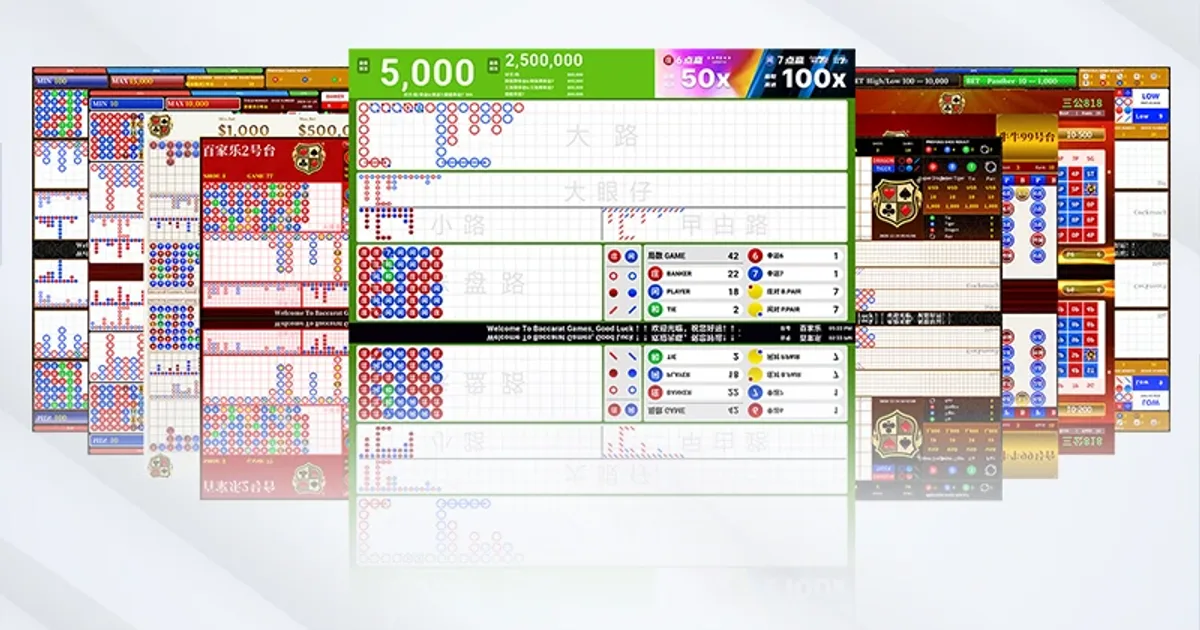
If you observe a live baccarat table, you will see a detailed, colorful grid displaying red and blue circles beneath the video feed:
The Big Road and Bead Plate
- The Bead Plate: Records exact chronological hand outcomes in a vertical grid (Red for Banker, Blue for Player, Green for Tie).
- The Big Road: Organizes consecutive wins into vertical columns (streaks), starting a new column whenever the winning side switches.
The Myth of Streak Prediction
Many casual players believe that studying roadmap patterns allows them to predict whether a "Banker streak" or "Player chop" is due to occur.
- The Mathematical Reality: Every shoe is an independent sequence of random card distributions. Cards remaining in the shoe have zero memory of previous rounds. Roadmaps are descriptive historical records of what has already transpired; they possess zero predictive power over future outcomes. Enjoy reading roadmaps as a traditional ritual, but never base wager sizes on the belief that a streak is "destined" to continue or break. For complete details, consult our Baccarat Roadmaps Guide.
Bankroll Discipline and Table Etiquette
Because baccarat rounds resolve in just 30 to 45 seconds, bankroll pacing is essential:
- The Default Rule: Always back the Banker Hand as your default baseline wager due to its superior 1.06% house edge.
- Avoid the Martingale System: Never double your bet size after a loss. Long losing streaks of 8 or 10 consecutive hands occur routinely in random probability, quickly hitting table maximum betting limits and wiping out entire bankrolls.
- Establish Session Limits: Decide on a strict win goal (e.g., +20% profit) and a strict loss limit (e.g., -30% of session bankroll). When either threshold is reached, step away from the table immediately. Review our Responsible Gaming Policy to set sensible personal boundaries.