
Understanding Cricket Betting Odds: Formats, Implied Probability, and Asian Handicaps

To the casual observer, betting odds look like arbitrary numbers flashing across a sportsbook screen. To a disciplined sports analyst, however, odds are the precise mathematical language of probability. Every decimal figure, fractional ratio, and plus-or-minus symbol represents a specific assessment of risk, a quantified chance of an event occurring, and a built-in commercial margin deducted by the bookmaker.
In Bangladesh, as digital sportsbooks have expanded to cover global cricket leagues like the BPL, IPL, and ICC World Cup, understanding how odds operate is the single most important skill any player must master.
Placing wagers without understanding implied probability is the equivalent of buying retail goods without knowing the price. Furthermore, exploring advanced markets—such as Asian Handicap lines on runs and wickets—allows knowledgeable bettors to unlock value in lopsided fixtures where traditional match-winner odds offer virtually zero return.
This comprehensive mathematical handbook, authored by senior cricket analyst Shakib Al-Amin, breaks down the mathematics of cricket betting odds. We explain how to read and convert decimal, fractional, and American odds, demonstrate how to calculate implied probability and bookmaker profit margins, detail the mechanics of cricket Asian Handicaps, and explain how to identify true mathematical market value.
The Three Primary Odds Formats Explained
Depending on your sportsbook settings or regional platform preferences, odds are displayed in three standardized formats:
Decimal Odds (European Format) — The South Asian Standard
Decimal odds are the universal standard across Bangladesh, Europe, Australia, and international exchange platforms. They represent the total payout returned for every 1.00 unit staked, including your original stake:
- The Payout Formula:
Total Return = Stake * Decimal Odds - The Profit Formula:
Net Profit = Stake * (Decimal Odds - 1) - Practical Example: If you stake 1,000 BDT on Bangladesh to defeat Sri Lanka at decimal odds of 2.15:
Total Return = 1,000 BDT * 2.15 = 2,150 BDTNet Profit = 2,150 BDT - 1,000 BDT = 1,150 BDT
- Why Decimals Are Preferred: Calculating returns and comparing prices across different platforms is mathematically instantaneous.
Fractional Odds (British / Traditional Format)
Commonly used in the United Kingdom and traditional horse racing, fractional odds represent the ratio of net profit won relative to the stake staked (expressed as Profit / Stake):
- Practical Example: Odds displayed as 6/5 (spoken as "six to five") mean that for every 5 BDT you stake, you make 6 BDT in net profit.
- Converting to Decimal: Divide the numerator by the denominator and add 1:
Decimal Odds = (6 / 5) + 1 = 1.20 + 1 = 2.20 - Odds of 1/2 ("one to two") mean you must risk 2 BDT to make 1 BDT profit (Decimal equivalent:
0.50 + 1 = 1.50).
American / Moneyline Odds
Predominant in North American sportsbooks, American odds use a plus (+) or minus (-) sign based on a 100-unit baseline:
- Minus (-) Odds (The Favorite): Indicates how much money you must stake to win 100 units of net profit. For example,
-150means you must risk 150 BDT to win 100 BDT profit (Decimal equivalent: 1.67). - Plus (+) Odds (The Underdog): Indicates the net profit won on a 100-unit stake. For example,
+130means a 100 BDT stake returns 130 BDT in net profit (Decimal equivalent: 2.30).
Calculating Implied Probability: The Core Mathematical Formula
The most fundamental concept in sports analytics is converting bookmaker odds into Implied Probability—the statistical percentage chance of winning that the odds represent:
The Implied Probability Equation for Decimal Odds
Implied Probability (%) = (1 / Decimal Odds) * 100
Real-World Mathematical Examples
Let us examine three typical cricket betting lines:
- Heavy Favorite (Decimal Odds 1.25):
Implied Probability = (1 / 1.25) * 100 = 80.0%The bookmaker’s price implies that the favorite has an 80% statistical chance of victory. - Balanced Contest (Decimal Odds 1.90):
Implied Probability = (1 / 1.90) * 100 = 52.63% - Significant Underdog (Decimal Odds 3.50):
Implied Probability = (1 / 3.50) * 100 = 28.57%
Calculating the Bookmaker’s Margin (The Vig or Overround)
In a theoretically perfect, fair mathematical market with zero commission, the combined implied probabilities of all possible outcomes in a match would equal exactly 100.0%.
However, commercial sportsbooks are profitable businesses. To ensure profitability regardless of the match result, bookmakers artificially compress odds, inflating the total probability sum beyond 100%. This surplus percentage is known as the Bookmaker's Margin, "vig" (vigorish), or "overround":
The Overround Formula
Total Market Overround (%) = Sum of All Implied Probabilities - 100%
Practical Calculation of a Real Cricket Market
Suppose a sportsbook posts the following two-way match-winner odds for a BPL match between Comilla Victorians and Rangpur Riders:
- Comilla Victorians to Win: Decimal Odds 1.91 (Implied Probability:
1 / 1.91 = 52.36%) - Rangpur Riders to Win: Decimal Odds 1.91 (Implied Probability:
1 / 1.91 = 52.36%) - Sum of Implied Probabilities:
52.36% + 52.36% = 104.72% - The Bookmaker Margin:
104.72% - 100.0% = 4.72%
The 4.72% represents the bookmaker’s structural mathematical edge built into that market. When comparing sportsbooks, lower overrounds (e.g., 2% to 4%) mean higher payouts for players, whereas high overrounds (e.g., 7% to 10%) indicate unfavorable, heavily taxed pricing.
What Is "Value Betting" in Cricket?
A common misconception among casual bettors is believing that sports betting is about "picking winners." A professional analyst does not ask *"Who will win?"*—they ask "Is the price offered higher than the true probability?"
The Definition of Positive Expected Value (+EV)
Value exists whenever your calculated statistical probability of an outcome is higher than the implied probability reflected in the bookmaker’s odds:
Value Formula: (True Probability * Decimal Odds) > 1.00
Step-by-Step Value Example
Suppose Bangladesh plays Sri Lanka at Mirpur. Your pre-game analysis (evaluating pitch wear, spin depth, and recent head-to-head records) leads you to conclude that Bangladesh has a 55% true probability (0.55) of winning:
- The Sportsbook's Odds on Bangladesh: 2.10 (Implied Probability:
1 / 2.10 = 47.6%). - Testing for Mathematical Value:
(0.55 * 2.10) = 1.155 - Because 1.155 is greater than 1.00, this wager possesses Positive Expected Value (+EV). The bookmaker is offering a payout based on a 47.6% chance for an event you have determined has a 55% chance of occurring. Over hundreds of similar wagers, backing positive value is the only mathematical method to achieve a long-term statistical edge.
Asian Handicap Lines in Cricket: Balancing Lopsided Matches
In international and franchise cricket, mismatches occur frequently—such as an elite test-playing nation facing an associate qualifier in an ICC T20 World Cup group match. In these fixtures, the favorite might trade at unbettable decimal odds of 1.08, while the underdog is priced at 8.00.
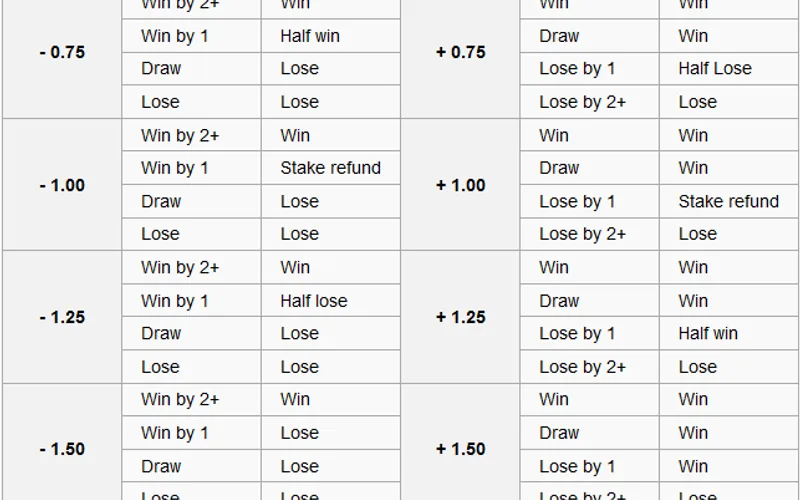
To create competitive, balanced wagering opportunities, sportsbooks offer Asian Handicap lines, which apply a virtual points or runs deficit/surplus to the teams before the match begins:
Runs Handicap (Applied to the Team Batting First)
A runs handicap gives the underdog a virtual head-start in runs, or imposes a runs penalty on the favorite:
- Example Line:
India (-32.5 Runs) vs Netherlands (+32.5 Runs)at balanced decimal odds of 1.90 each. - If you back India (-32.5 Runs): India must bat first and defeat the Netherlands by at least 33 runs for your bet to win. If India wins by 20 runs, your bet is settled as a loss because applying the -32.5 handicap results in a net deficit.
- If you back Netherlands (+32.5 Runs): Your bet wins if the Netherlands wins the match outright OR loses by 32 runs or fewer.
Wickets Handicap (Applied to the Team Chasing)
When a favorite is chasing a target in the second innings, handicaps are framed in remaining wickets:
- Example Line:
Australia (-4.5 Wickets) vs Scotland (+4.5 Wickets). - If you back Australia (-4.5 Wickets): Australia must chase down the target losing 4 or fewer wickets (winning by 5 or more wickets). If Australia loses 6 wickets during the chase, the handicap bet loses even though Australia won the actual match.
Summary Rules for Navigating Cricket Odds
To maximize your analytical efficiency, maintain these golden operational rules:
- Always Convert to Implied Probability: Before placing any bet, calculate the percentage chance the odds imply. Ask yourself honestly: Do I genuinely believe this outcome will occur more frequently than this percentage suggests?
- Shop for the Lowest Bookmaker Margin: Different sportsbooks offer varying prices on the same match. Utilize platforms that maintain competitive, low-margin odds (such as Takabet) to avoid surrendering value to high overrounds.
- Explore Asian Handicaps on Heavy Favorites: When favorites trade at unbettable 1.10 to 1.20 odds, look to the handicap markets to back decisive margins at healthy 1.85 to 1.95 prices.
- Practice Strict Bankroll Unit Sizing: Never risk more than 1% to 2% of your designated entertainment bankroll on any single odds line, and consult our Responsible Gaming Policy to set hard deposit limits.